
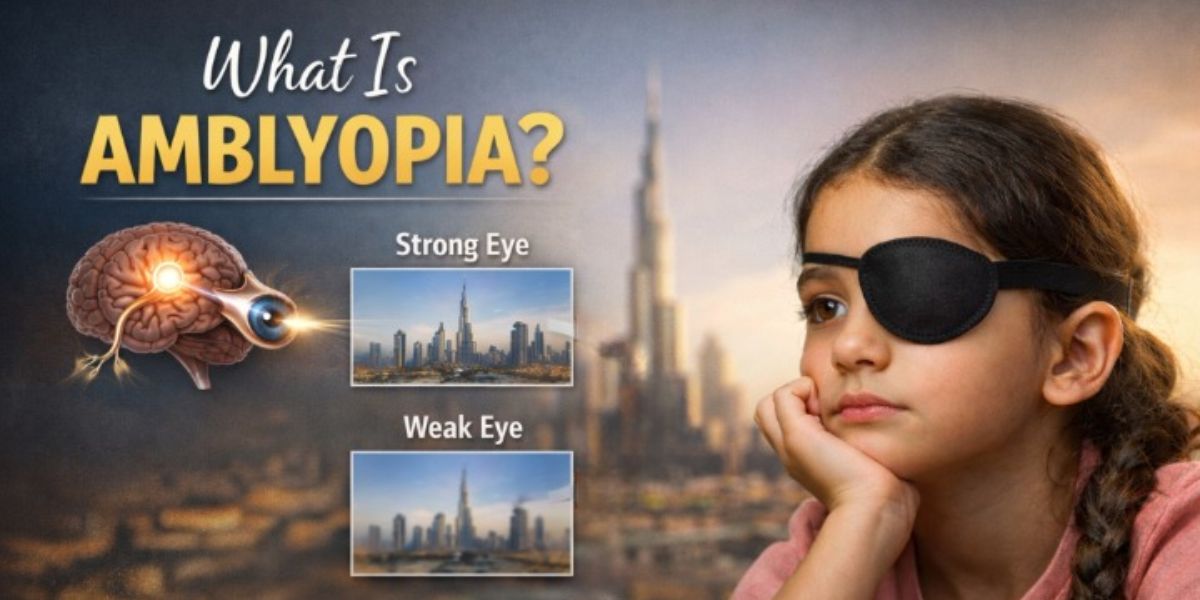
Vision is one of the most precious senses we possess, yet many parents are often unaware of the complex processes that allow us to see clearly. Visual development is a journey that begins at birth and continues throughout childhood. During this critical period, the connection between the eyes and the brain must be established correctly. When this connection is disrupted, it can lead to a condition that affects a significant number of children worldwide. Many concerned parents visit our clinic asking What is amblyopia, seeking to understand why their child might be struggling with vision despite having healthy-looking eyes. Understanding amblyopia is the first step toward ensuring a lifetime of clear sight. Commonly referred to as lazy eye, this condition is not just an issue with the eye itself but a complex problem involving the brain. If left untreated, it can lead to permanent vision impairment, which is why early detection is paramount.
To truly grasp the amblyopia meaning, we must look beyond the eyeball and consider the brain. Healthy vision requires a seamless partnership between the retina, the optic nerve, and the visual cortex in the brain. When we look at an object, both eyes send distinct images to the brain, which then fuses them into a single, three-dimensional picture. This process is known as binocular vision. However, in an amblyopia eye condition, the brain favours one eye over the other. The brain effectively ignores the signals from the "weaker" eye to avoid double vision or confusion. Over time, the neural pathways from that eye weaken, leading to the condition known as lazy eye. It is crucial to understand that the eye is not actually "lazy" in the sense of being inactive; rather, the brain-eye connection has not developed properly. This creates a significant lazy eye problem where the physical structure of the eye might look perfect, yet the patient cannot see clearly through it.
Parents often ask what the main cause of amblyopia is and whether it can be prevented. The condition generally stems from anything that interferes with clear vision in either eye during the critical period of childhood development. There are generally three main categories that define the causes of amblyopia. The first is strabismus, where the eyes are misaligned. If one eye turns in, out, up, or down, the brain will eventually switch off the image from the misaligned eye to prevent double vision. The second cause involves refractive error. This occurs when there is a significant difference in vision between the two eyes due to conditions like myopia (nearsightedness), hyperopia (farsightedness), or astigmatism. In these cases, the brain relies exclusively on the eye with the better focus. The third and rarest cause is deprivation, often due to a congenital cataract or a droopy eyelid that physically blocks vision. Understanding these variations helps answer what the four types of amblyopia are, which include strabismic, refractive, deprivation, and mixed mechanisms. Furthermore, many wonder if amblyopia is genetic. While the condition itself is not always directly inherited, the predisposing factors, such as strabismus and high refractive errors, often run in families, making family history a vital risk factor.
Detecting this condition can be challenging because children rarely complain about poor vision. They assume thatwhatw they see is how everyone sees. Recognising lazy eye symptoms requires careful observation. You might notice a child squinting, tilting their head to see better, or having poor depth perception, which can result in clumsiness. In some cases of strabismus, the wandering eye is visible, but in cases caused by refractive errors, the eyes may look perfectly normal. This invisible nature makes the amblyopia eye condition dangerous if regular screenings are ignored. Early diagnosis is the gold standard for success. Amblyopia in children is most effectively treated before the age of seven when the visual pathways are still malleable. However, failing to diagnose this childhood eye disorder early can lead to permanent vision loss in the affected eye. Parents searching for the answer tthis a serious problem must understand that it is indeed the leading cause of decreased vision among children. This highlights the necessity of visiting a pediatric ophthalmologist for routine checks, even if no obvious issues are present.
A common misconception is that this is solely a childhood issue and cannot be corrected later in life. While treatment is most effective at a young age, the concept of neuroplasticity suggests that the adult brain retains some ability to change. Lazy eye in adults is a valid concern, and many individuals seek an adult eye checkup in Dubai, hoping for a solution. While the window for rapid improvement closes after childhood, older children and adults can still benefit from specific treatments. It is important to differentiate between lazy eye and amblyopia in casual conversation, though they refer to the same clinical entity. The key difference lies in the permanence of the vision loss if untreated. For adults, the goal might be to improve functional vision or depth perception rather than achieving perfect acuity. Consulting a lazy eye doctor in Dubai can provide adults with a realistic roadmap for what improvements are possible, proving that it is never too late to seek an evaluation.
Once a diagnosis is confirmed, the next question is, naturally, how can you fix amblyopia? The amblyopia treatment plan depends entirely on the severity and the underlying cause. The first step is almost always correcting any refractive errors using corrective glasses or contact lenses. This ensures that a clear image is sent to the retina. If cataracts are present, surgery is required. Once the optics are corrected, the brain must be retrained to use the weaker eye. This is traditionally done through eye patching, where the stronger eye is covered for several hours a day, forcing the brain to utilise the weaker eye. Another method involves using atropine drops to temporarily blur the vision in the strong eye. Modern medicine also incorporates vision therapy and specific eye exercises designed to enhance binocular vision. For parents seeking lazy eye treatment in Dubai, it is essential to find a facility that offers a holistic approach. The treatment is not an overnight fix; it requires patience and consistency. Whether it involves patching or advanced digital therapies, the goal is to strengthen the neural connections in the visual cortex.
When it comes to your child's vision, you want the absolute best care available. Dubai has emerged as a hub for medical excellence, yet finding the right specialist requires diligence. Parents often search for the best pediatric ophthalmologist in Dubai or a specialised eye specialist for kids in Dubai to ensure their children receive top-tier care. The management of Amblyopia requires a doctor who is not only skilled in medical procedures but also compassionate towards children who may be anxious about eye exams. A general ophthalmologist in Dubai might be able to diagnose the issue, but a specialist with fellowship training in pediatric care possesses the nuanced understanding required for long-term management. From managing complex strabismus to tailoring vision therapy programs, the right specialist makes all the difference. Those seeking an eye specialist doctor in Dubai should look for credentials that demonstrate deep expertise in neuro-ophthalmology and pediatric eye conditions.
If you are looking for an expert who combines world-class training with a compassionate approach, look no further than Dr. Medha Sharma. As the founder of Vision for Children, she brings an unparalleled level of expertise to the region. Dr. Medha Sharma is an accomplished pediatric ophthalmologist with an extraordinary educational background that sets her apart. She completed her ophthalmology training and fellowship in Cornea, Squint, and Neuro-Ophthalmology at the prestigious All India Institute of Medical Sciences (AIIMS) in Delhi, India. Furthermore, she enhanced her expertise by completing a fellowship in Pediatric Ophthalmology and Strabismus at the world-renowned Harvard Medical School in Boston, USA. This combination of Eastern and Western medical training allows her to offer the most advanced amblyopia treatment in Dubai. Her deep understanding of the condition ensures that every patient, whether a toddler or an adult, receives a customised treatment plan effectively targeting their specific visual challenges.
At Vision for Children, we understand that treating a child requires a different approach than treating an adult. We are not just another eye hospital; we are a dedicated eye clinic for lazy eye in Dubai. I designed to make children feel comfortable and safe. Under the guidance of Dr. Medha Sharma, our clinic utilises state-of-the-art technology to diagnose and treat various eye disorders. We believe that Amblyopia is a condition that can be conquered with the right partnership between the doctor, parent, and child. Our facility is equipped to handle everything from routine screenings to complex management of congenital cataracts and squints. We pride ourselves on being the best eye clinic for amblyopia because we focus on results and patient experience. We educate parents on the root cause of lazy eye and guide them through every step of the therapy, ensuring that the treatment at home, such as patching, is successful.
Choosing the right amblyopia doctor is the most critical decision you can make for your child's sight. Dr. Medha Sharma acts as a partner in your child’s visual development. As a leading amblyopia eye specialist and lazy eye ophthalmologist, she employs a patient-centred approach that combines rigorous medical research with personal care. Whether you are looking for a pediatric eye doctor for lazy eye in Dubai or an eye doctor for lazy eye for an older child, our clinic offers comprehensive solutions. We go beyond simple prescriptions; we focus on restoring binocular vision and ensuring that your child reaches their full visual potential. With Dr. Medha Sharma and her team, you can trust that your child's vision is in the safest hands.
Understanding Amblyopia is the first step toward correcting it. It is a serious vision problem that requires early intervention and consistent treatment. From recognising the signs to understanding the difference between lazy eye and other conditions, education is power. With options ranging from glasses to vision therapy, improvement is highly achievable. If you suspect your child has a vision issue, or if you are an adult seeking answers, do not delay.
Take the first step towards a crystal-clear vision today. Contact Vision for Children to schedule a consultation with Dr. Medha Sharma, the leading amblyopia specialist in Dubai. Visit our Google Business Profile to read reviews from happy parents and learn more about our services. Your vision deserves the best care.